This week, I edited a Wikipedia article for the first time – and to my surprise, it felt emotional.
I grew up in Pegram, Tennessee, and in May of 2010, our town was hit hard by a flood. I was stuck at Girl Scout camp when it happened, with no cell service or power for days. I couldn’t contact my family at all, and no one could pick me up because roads were flooded or unsafe. When I finally got out, I had to stay with my aunt and then my grandparents. My neighborhood had been flooded in. I didn’t return home for over a week. When I did, most of the homes on my street were completely destroyed. The entire neighborhood reeked of mold and decay. It was a devastating time for my family and community, and it left an imprint on me that hasn’t faded.
So when I noticed that Pegram wasn’t even mentioned on the Wikipedia page for the 2010 Tennessee floods, it stung. Like the pain of it had been erased.
That’s what motivated my edit.
I created a new section on the Wikipedia page titled “Impact on Cheatham County” and added a few sentences about how the flood affected areas like Pegram, Ashland City, and Kingston Springs. I found two credible sources – one from the Harpeth Conservancy and one from The Tennessean – that documented the damage to Kingston Springs Elementary and other buildings. I also posted in the article’s Talk section explaining that I was new to editing and that I grew up in the area and wanted to help improve the article with sourced information.
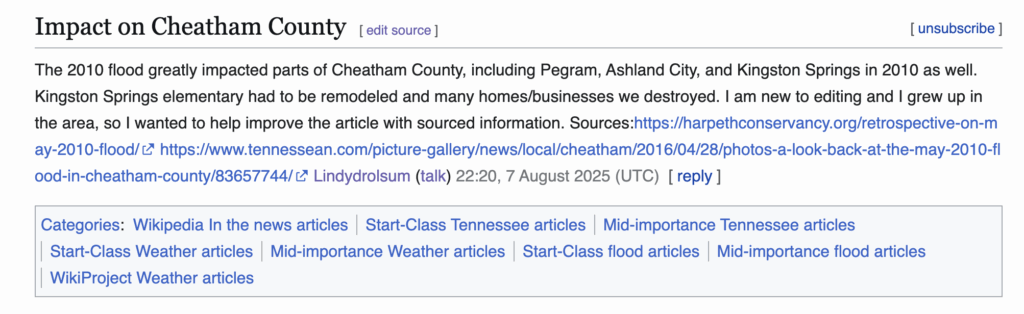
(Here’s a screenshot of my edit in progress – you can also view it live on the Wikipedia page here.)
Editing the article made me realize just how many stories are missing from our shared memory. Wikipedia feels neutral on the surface, but what gets left out tells a story too. It felt powerful to bring even a small part of my community’s truth into that space. My neighbors mattered. Our losses mattered. And now, they’re not invisible on one of the most-read websites in the world.
I also learned how much work goes into maintaining Wikipedia’s standards for citations and neutrality. Even though I was adding something I personally experienced, I couldn’t rely on memory alone. I had to track down news articles and nonprofit archives to back up what I remembered. It reminded me how important it is to blend lived experience with verifiable sources – and how often community knowledge is left out simply because it hasn’t been formally documented. This experience made me want to contribute more, not just as a reader but as someone who cares about whose stories get remembered.
Wikipedia is far from perfect, but it’s built by people like us. That means we can shape what it says. I’m proud of the small change I made, and I hope it inspires someone else from a forgotten corner to do the same.
Leave a Reply